
CLAIM BASICS · REAR-END COLLISIONS
What to do if you get rear-ended
Being hit from behind starts the same duties as any crash, plus a choice of claim paths. Here is what to do first and what to keep.
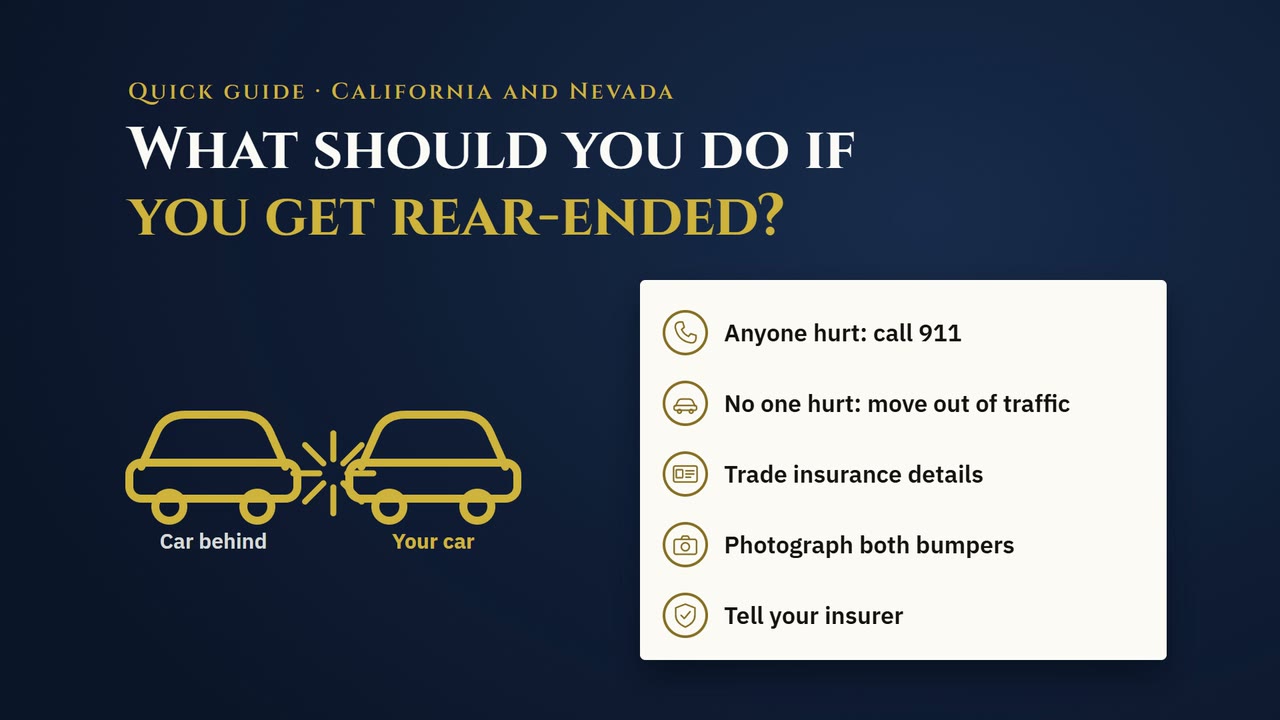
If you get rear-ended, check for injuries and call 911 if anyone is hurt; if no one is hurt, move out of traffic. Show and collect licenses, registration and insurance details, photograph both bumpers and the scene, and tell your insurer right away. In California, the driver who was hit files an SR-1 too: DMV says each driver must report within 10 days when the rule applies, whether or not they caused the collision. CA Driver Handbook, Sec. 10
Video · 2:59 · Rear Ended? What to Do If You Get Rear-Ended (California and Nevada)
Video transcript
What should you do if you get rear-ended? Call 911 if anyone is hurt. If no one is, move out of traffic, trade insurance details, photograph both bumpers, and tell your insurer. In California, the driver who was hit files an SR-1 too. DMV says each driver reports within 10 days when the rule applies, whether or not they caused the collision. This guide is from LegalMax Consulting. We help with car-accident claim paperwork, in English and Spanish. LegalMax is not a law firm and does not provide legal advice.
Step one: trade documents, not opinions. Show your license, registration and insurance. Get the other driver's name, phone, license number, plate, and vehicle identification number. Step two: photograph both ends of the impact, both plates, and the scene, including traffic controls. Get witness names before anyone leaves.
Step three: call your own insurer, even if you plan to claim against the other driver. The Department of Insurance advises doing it immediately. Step four: the 10-day report. California's SR-1 applies when damage is over $1,000 or anyone is hurt, even slightly. Nevada uses $750, unless a police officer investigated and the report has the insurance details.
Step five: pick a claim path. The other driver's liability coverage protects that driver only when that driver is liable. Your own collision coverage pays regardless of fault. If your insurer pays, it may ask the other side to reimburse it. It must tell you whether it will, and if it does, it must include your deductible. So never sign a release in exchange for your deductible. The Department of Insurance says that can jeopardize your insurer's recovery. Step six: watch for hidden damage. If more turns up during repairs, the shop asks the insurer to approve the added cost.
Who is at fault? Being hit from behind does not settle it by itself. Insurers investigate, and California's courts note it is not always easy to tell who is responsible. LegalMax does not decide fault. Ask your questions in writing.
Important: this guide is general information. LegalMax is not a law firm and does not provide legal advice. No outcome is guaranteed. For a legal question, consult a licensed attorney. Four details are enough to start: name, phone, accident date, and carrier. Call (562) 287-5090, or visit legalmaxconsulting.com.
1. Key takeaways
- Being the car in front does not close the fault question by itself. Insurers investigate, and California’s court self-help guide says it is not always easy to tell who is responsible for damage. California Courts Self-Help
- The SR-1 is yours to file, too. California DMV says each driver reports within 10 days when property damage is over $1,000 or anyone is hurt, even slightly, whether or not that driver caused it. CA Driver Handbook, Sec. 10
- A reported collision goes on your California driver record no matter who caused it, according to the DMV handbook. CA Driver Handbook, Sec. 10
- You have two claim paths: the other driver’s liability insurer, or your own collision coverage. If your insurer pays first, it may seek the money back from the other side (subrogation) and must tell you if it will. CA Department of Insurance
- Never trade a signed release for your deductible. The Department of Insurance says that kind of agreement can jeopardize your insurer’s right of recovery. CA Department of Insurance
2. Step by step after a rear-end collision
- Stop and check on everyone. DMV says you must stop, call 911 right away if anyone is hurt, and move your vehicle out of traffic if no one is hurt, then call 911. CA Driver Handbook, Sec. 10
- Trade documents, not opinions. DMV says to show your license, registration card, insurance information and current address to the other driver and to law enforcement. The Department of Insurance adds the other driver’s name, phone number and license number, plus plates and vehicle identification numbers. Ask to see the documents so the details are accurate. CA Driver Handbook, Sec. 10 CA Department of Insurance
- Photograph both ends of the impact. Get your rear bumper, trunk and lights, the front of the car behind you, both plates, and the scene itself. The Department of Insurance specifically mentions traffic controls and visual obstacles. Write down witness names and numbers before anyone leaves. CA Department of Insurance
- Know the injury reporting rule. The California DMV handbook says a report to law enforcement is required within 24 hours if anyone is injured or killed. CA Driver Handbook, Sec. 10
- Call your own insurer even if you plan to claim against the other driver. The Department of Insurance advises notifying your agent or company immediately. Write the claim number on the first page of your folder. CA Department of Insurance
- Check the 10-day DMV rule. California: SR-1 within 10 days for damage over $1,000 or any injury or death, on public roads or private property. Nevada: a report within 10 days for injury, death or apparent damage of $750 or more, unless a police officer investigated and the report contains the insurance details. CA DMV: SR-1 NRS 484E.070
- Pick a claim path and ask your questions in writing. Your insurer must acknowledge a claim within 15 calendar days of notice and tell you what it needs for proof of claim. 10 CCR § 2695.5
- Watch for hidden damage. The Department of Insurance explains that if more damage turns up during repairs, the shop contacts the insurer to approve the added cost, and the insurer may send someone to re-inspect. A California insurer cannot require you to use a specific repair shop. CA Department of Insurance 10 CCR § 2695.8
3. Two ways to get the car fixed
| Claim with the other driver’s insurer | Claim under your own collision coverage | |
|---|---|---|
| What it relies on | The other driver’s liability coverage, which protects that driver only when that driver is liable | Your own policy; collision covers your vehicle regardless of who is at fault |
| Money questions | Ask the adjuster in writing how any payment is calculated | Your insurer may ask the other party to reimburse what it paid; if it pursues that, it must include your deductible |
| Rental car | Ask the adjuster in writing what is covered | Only if you bought rental vehicle coverage |
| If the insurer says no | A California insurer that denies the claim or disputes liability or damages must say so in writing | A denial must be in writing, list its reasons and say you may have it reviewed by the Department of Insurance |
Coverage descriptions in the first two rows follow the Nevada Division of Insurance’s plain-language definitions. Your policy wording controls; read your declarations page and ask your insurer which section applies. Nevada Division of Insurance
4. California and Nevada side by side
| California | Nevada | |
|---|---|---|
| Report to DMV | SR-1 within 10 days: damage over $1,000, or anyone injured or killed, even minor injuries | Within 10 days: injury, death, or apparent damage of $750 or more |
| Who reports | Each driver, whether or not they caused the collision (or an agent, broker or legal representative) | Not required when a police officer investigated and the report contains the insurance details |
| Following-distance guidance | DMV handbook: use the three-second rule; a tailgater may not have time to react if the car ahead brakes suddenly | NRS 484B.127: a driver shall not follow more closely than is reasonable and prudent |
These following-distance rules describe safe driving. Whether one was broken in a particular crash is a fact question for the insurers involved, and a legal question for a licensed attorney.
5. How fault gets decided after you are rear-ended
This page does not decide fault, and LegalMax does not either. The insurers involved investigate the facts, and California’s court self-help guide notes that it is not always easy to tell who is responsible for damage. Ask each insurer in writing how it reached its decision, and keep every letter with your claim file. For a legal question about fault, consult a licensed attorney. California Courts Self-Help
LegalMax connects accident victims with the right help in English and Spanish and is not a law firm. Fault, coverage and payment are decided by the insurers involved, not by this guide. No outcome is guaranteed.
6. What LegalMax hears on the phone
Of the 133 people who gave LegalMax a clear answer, 102 said no one was hurt and 31 said someone was. These calls cover all kinds of crashes, not only rear-end collisions.
Common questions
Is the driver who rear-ended me automatically at fault?
Not automatically, as far as this page can say. The insurers investigate the facts, and neither this page nor LegalMax decides fault. Ask the insurer in writing how it reached its decision. For a legal question about responsibility, consult a licensed attorney.
I was the one who got hit. Do I still have to file an SR-1?
In California, yes, when the rule applies. The DMV handbook says each driver must file within 10 days if damage is over $1,000 or anyone was hurt, whether or not they caused the collision, and even if it happened on private property.
Will a rear-end crash show up on my driving record if I did not cause it?
The California DMV handbook says a reported collision is added to your driver record and that it does not matter who caused it. How your insurer treats the crash is a separate question; ask it in writing.
Should I claim through my insurance or the other driver’s?
Either path can work. Your collision coverage pays regardless of fault, subject to your deductible, and your insurer may later recover from the other party. A claim with the other driver’s insurer depends on that driver being found liable.
Can I get my deductible back?
The Department of Insurance says your insurer must tell you whether it will pursue subrogation. If it does, it must include your deductible; if it recovers only part of what it paid, most companies refund the same share of your deductible.
The bumper damage looks small. Do I still need photos and a claim number?
Yes, keep both. The Department of Insurance notes that more damage can turn up during repairs, which then needs the insurer’s approval, and DMV’s SR-1 rule turns on damage over $1,000, which is hard to judge from the outside of a bumper.
The other driver offered to pay my deductible if I sign something. Is that okay?
With a collision claim open, the Department of Insurance says you cannot sign a paper that frees the other driver in return for your deductible, because it can undercut your insurer’s right to recover the money. Talk to your insurer before you sign anything.