
CLAIM BASICS · SMALL CRASHES
Fender bender: what to do and whether to file a claim
A small crash still comes with duties at the scene, a possible 10-day DMV report and a call to your insurer. Here is the order, for California and Nevada.
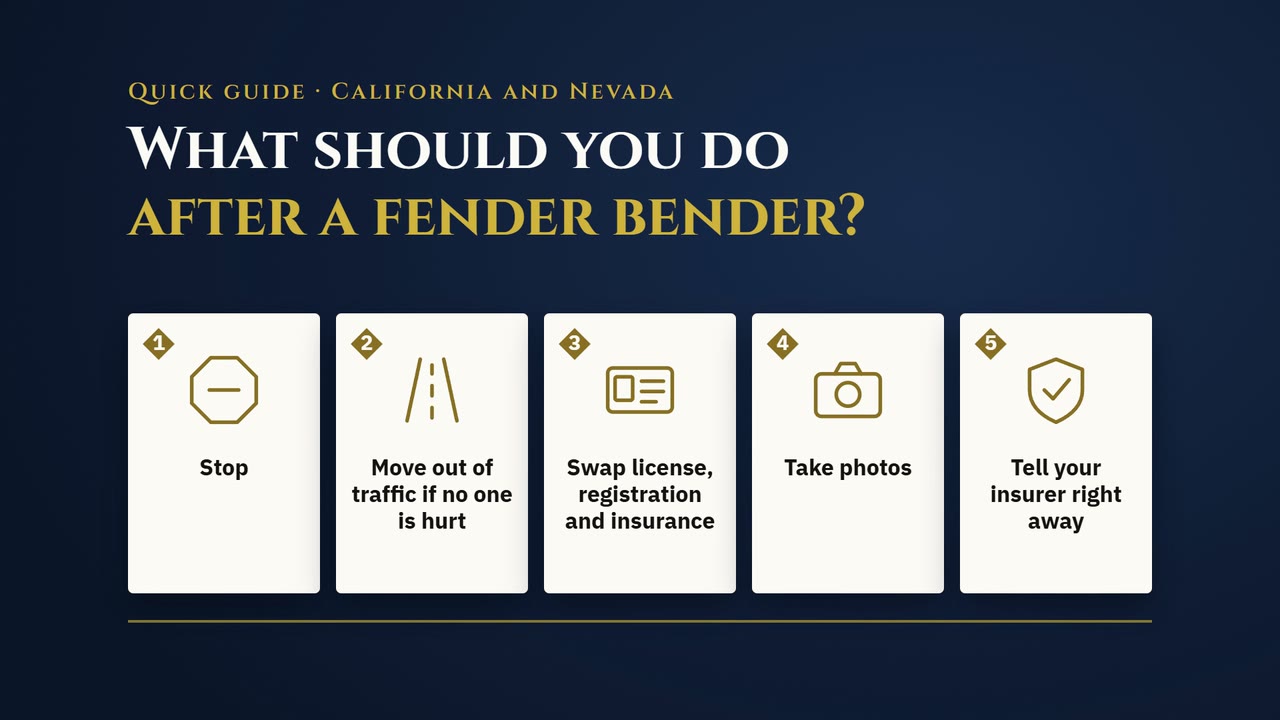
"Fender bender" is the everyday name for a small crash. California’s Department of Insurance uses it for the light end of the scale, the opposite of "a major injury accident". A small crash still carries real duties: stop, move out of traffic if nobody is hurt, show your license, registration and insurance, take photos, and tell your insurer right away. In California, the DMV wants an SR-1 within 10 days when anyone is hurt, even slightly, or property damage is over $1,000. CA Department of Insurance CA DMV: SR-1
Video · 3:02 · Fender Bender: What to Do and Whether to File a Claim
Video transcript
What should you do after a fender bender? Stop, move out of traffic if no one is hurt, swap license, registration and insurance details, take photos, and tell your insurer right away. In California, the DMV wants an SR-1 within 10 days when anyone is hurt, even slightly, or property damage is over $1,000. This guide is from LegalMax Consulting. We help with car-accident claim paperwork, in English and Spanish. LegalMax is not a law firm and does not provide legal advice. Let's take it step by step.
"Fender bender" is the everyday name for a small crash. California's Department of Insurance uses it for the light end of the scale. Small does not mean exempt.
Step one: stop. California DMV's handbook says leaving the scene of an accident is a hit-and-run. If anyone is hurt, call 911 right away. Step two: if no one is hurt, move your car out of traffic, then call 911. In Nevada, a car that blocks traffic and can be moved safely has to come out of the lanes. Step three: show your license, registration card, insurance information and current address, and note the other car's plates. Step four: take photos of the damage and the scene, including traffic controls. Write down witness names and phone numbers. Step five: try to notify the police, even though some agencies will not come, for example on private property. Step six: tell your agent or insurer immediately. You do not need the final repair cost first. Step seven: check the DMV report. Each driver files the SR-1, at fault or not, even on private property. Law enforcement will not file it for you.
Thinking of trading cash instead? With a collision claim, the Department of Insurance says you cannot release the other party in exchange for your deductible. And a reported collision goes on your driver record, no matter who caused it. For a small dent, the insurer may ask for competitive repair estimates. In California, an insurer may not require a specific repair shop. Tapped a parked car and cannot find the owner? Leave a note with your name, phone number and address, and report it to law enforcement.
Important: this is general information. LegalMax is not a law firm, does not provide legal advice, and does not predict what an insurer will pay. LegalMax can help you sort photos, estimates and the claim number, in English or Spanish. Four details are enough to get moving: name, phone, accident date and carrier. Call (562) 287-5090, or visit legalmaxconsulting.com.
1. Five things to know
- Small does not mean exempt. California DMV’s driver handbook says each driver files the SR-1 whether or not they caused the collision, and even when it happened on private property. Law enforcement will not file it for you. CA Driver Handbook, Sec. 10
- No one hurt? Clear the lane. The handbook says to move your vehicle out of traffic if no one is hurt, then call 911. Nevada law requires moving a car out of the traffic lanes when it creates a hazard and can be moved safely. CA Driver Handbook, Sec. 10 NRS Chapter 484E
- Paperwork is swapped, not guessed. California drivers show their license, registration card, insurance information and current address to the other driver. CA Driver Handbook, Sec. 10
- Your insurer hears about it early. The Department of Insurance tells drivers to notify their agent or insurance company immediately. You do not need the final repair cost first. CA Department of Insurance
- A cash handshake has limits. If you have a collision claim, the Department of Insurance says you cannot sign an agreement releasing the other party in exchange for payment of your deductible. CA Department of Insurance
2. Step by step after a fender bender
- Stop. DMV’s handbook is direct: you must stop, and leaving the scene of an accident is a hit-and-run. CA Driver Handbook, Sec. 10
- Check for injuries. Call 911 right away if anyone is hurt.
- Get out of the travel lanes. With no injuries, move your car out of traffic, then call 911, as the handbook says. In Nevada, a car that blocks traffic and can be moved safely has to come out of the lanes. CA Driver Handbook, Sec. 10 NRS Chapter 484E
- Show and collect documents. Show your license, vehicle registration card, insurance information and current address. The Department of Insurance also suggests asking to see the other driver’s license and registration to confirm what you wrote down, and noting plates and vehicle identification numbers. CA Department of Insurance CA Driver Handbook, Sec. 10
- Photograph before anything moves. Take pictures of the damage and of the scene, including traffic controls and anything that blocked the view. Write down passenger and witness names, addresses and phone numbers. CA Department of Insurance
- Try to reach the police. The Department of Insurance says some police agencies will not come to every crash, for example on private property, but you should still attempt to notify them. CA Department of Insurance
- Call your agent or insurer. The Department of Insurance says immediately, so do not wait for a repair quote. CA Department of Insurance
- Check the 10-day DMV report. In California, decide early whether the SR-1 applies. In Nevada, the report rule uses its own threshold (see the table). CA DMV: SR-1 NRS 484E.070
- Start one folder. Claim number, photos, estimates, receipts and every message, each with its date.
3. Who to tell after a fender bender, by state
| Who | California | Nevada |
|---|---|---|
| The other driver | Show your license, registration card, insurance information and current address (DMV handbook). | Give your name, address and the vehicle’s registration number; show your license on request (NRS 484E.030). |
| Police | Attempt to notify them, even if they may not come (Department of Insurance). A report to law enforcement is due within 24 hours only when someone is injured or killed (DMV handbook). | With no officer present, a crash on a highway gets reported right away to the nearest police office or the Nevada Highway Patrol (NRS 484E.030). |
| State DMV | SR-1 within 10 days if anyone is hurt, no matter how minor, or killed, or property damage is over $1,000 (DMV). | Report within 10 days for injury, death or apparent damage of $750 or more, unless an officer investigated and the officer’s report lists each driver’s insurance details (NRS 484E.070). |
| Your insurer | Notify your agent or insurance company immediately (Department of Insurance). | Read your policy’s notice terms and call your insurer. |
4. What each office handles
| Office | What it handles | What it does not do |
|---|---|---|
| California DMV | The SR-1 report, and the collision entry on your driver record | Open or pay an insurance claim |
| Police or CHP | The scene and any law enforcement report | File your SR-1 (the handbook says law enforcement will not make it for you) |
| Your insurer | Your claim under your own policy | Replace the DMV report |
| California Department of Insurance | Consumer questions and complaints about insurers, online or at 1-800-927-4357 | Repair your car or decide fault for you |
| LegalMax | Helping you get connected with a body shop for the car, or with a chiropractor or licensed attorney if someone was hurt, in English or Spanish | Give legal advice, decide coverage, or file reports in your place |
5. Should you file a claim for a fender bender?
That choice is yours, and LegalMax does not predict what an insurer will pay or how a premium may change. These official points shape it:
- Notice is separate from the decision. The Department of Insurance advises notifying your agent or insurance company immediately, whatever the size of the dent. CA Department of Insurance
- The DMV report does not wait for a claim. If the SR-1 rule applies, it applies whether or not anyone files a claim, and DMV says it is in addition to any report made to the police, CHP or your insurance company. CA DMV: SR-1
- Your record. The DMV handbook says a reported collision goes on your driver record, and it does not matter who caused it. CA Driver Handbook, Sec. 10
- Side agreements. When you have a collision claim, your insurer may seek the money it paid from the at-fault party (subrogation). The Department of Insurance says you cannot sign a release of the other party in exchange for your deductible, and that your insurer must tell you whether it will pursue subrogation. CA Department of Insurance
If you want to know how a claim might affect your premium, ask your insurer and keep the answer in writing.
6. Getting a small dent estimated and repaired
- Competitive estimates. The Department of Insurance says that when damage is relatively minor, the insurer may ask you to submit competitive repair estimates instead of sending an adjuster. CA Department of Insurance
- Hidden damage. If a shop finds more damage during the repair, it contacts the insurer to approve the extra cost, and the insurer may send someone to look again. CA Department of Insurance
- Your shop, your copy. In California, an insurer may not require a specific repair shop, and when a partial loss is settled on the insurer’s estimate, you get a copy. Nevada’s regulation also requires the insurer to give the claimant a copy of its estimate. NAC 686A.680 10 CCR § 2695.8
7. If you tapped a parked car
California’s handbook says to try to find the owner. If you cannot, leave a note with your name, phone number and address, attach it securely, and report the collision to law enforcement. Nevada law asks for a secure written notice with the driver’s and owner’s names and addresses, and, for a crash on a highway, an immediate notice to the nearest police office or the Nevada Highway Patrol. CA Driver Handbook, Sec. 10 NRS Chapter 484E
8. When a small crash turns out to involve an injury
California DMV counts an injury "no matter how minor" when deciding whether the SR-1 is due. California Courts also notes that one accident can cause both property damage to the car and personal injury to the people in it. Keep the car folder and any medical paperwork apart. California Courts Self-Help CA DMV: SR-1
From LegalMax’s own phone records: Of the 133 people who gave LegalMax a clear answer, 102 said no one was hurt and 31 said someone was.
LegalMax connects accident victims with the right help in English and Spanish and is not a law firm. Whether to file, and how a claim affects a premium, are questions for you and your insurer; this page is general information and promises no outcome.
Common questions
What counts as a fender bender?
It is the common name for a small crash. California’s Department of Insurance places the "fender bender" at the small end, against a major injury accident. The reporting rules do not use the word; they turn on injury, death and the amount of property damage.
Do I have to call the police for a fender bender in California?
DMV’s handbook requires a report to law enforcement within 24 hours when someone is injured or killed. If you hit a parked car and cannot find the owner, it says to report the collision to law enforcement as well. For other crashes, the Department of Insurance still says to attempt to notify the police, even though some agencies will not respond.
Do I need an SR-1 for a fender bender?
Yes, when someone is hurt, even slightly, or property damage is over $1,000. Each driver files, whether or not they caused it, within 10 days. You or your insurance agent, broker or legal representative can complete it.
Can we just trade cash and keep insurance out of it?
The DMV report rule still applies if the crash meets it. If you have a collision claim, the Department of Insurance says you cannot release the other party in exchange for your deductible. For a legal question about a private agreement, consult a licensed attorney.
Will a fender bender show on my driving record?
The DMV handbook says that when you report a collision, DMV adds it to your driver record, and it does not matter who caused it. Ask your insurer directly how it treats reported collisions.
What is different in Nevada?
A car that blocks traffic and can be moved safely must come out of the lanes. The DMV report is due within 10 days for injury, death or apparent damage of $750 or more, unless an officer investigated and the officer’s report already lists each driver’s insurance company, policy number and coverage dates.
Can LegalMax handle my fender bender claim?
No. LegalMax does not handle claims. If the dent needs fixing, it can help you find a body shop, and if you were hurt, a chiropractor, in English or Spanish. We are not your insurer, we do not decide coverage, and contacting us does not replace reporting to DMV or your insurance company.